HomeCase StudyB2B Store for Metalworking Tools on CS-Cart
B2B store for metalworking tools on CS-Cart
The client runs an online store selling metalworking tools: inserts and toolholders for turning, threading tools, milling cutters, and milling tooling. The client’s identity cannot be disclosed due to an NDA.
Industry: metalworking tools
Country: Russia
The challenge
The client had built the CS-Cart store largely on their own but ran into tasks at launch that couldn’t be solved in-house.
The hardest part was setting up correct data exchange between CS-Cart and 1C (the accounting and ERP system widely used in Russia). At the start, there was no clear picture of how to structure the exchange so that goods would be tracked by customs declaration numbers and bank transfer payments would be recorded automatically. Shipping and payment services also had to be connected.
A separate task concerned product page logic. The niche has a specific challenge: thousands of SKUs that must match each other precisely. A given insert doesn’t fit every toolholder, and a given spare part doesn’t fit every tool. Buyers — mostly B2B customers, including manufacturing and machining companies — need to find compatible items quickly, without digging through technical documentation by hand.
The third area was platform support and development: upgrading CS-Cart and the UniTheme design theme, which produced technical errors when attempted in-house.
Main objectives:
01 Support the store launch and provide ongoing technical support. Connect shipping and payment services.
02 Set up correct data exchange between CS-Cart and 1C, including goods tracking by customs declaration numbers and automatic recording of bank transfer payments.
03 Develop functionality for quickly finding inserts and spare parts compatible with toolholders and milling cutters.
04 Keep the CS-Cart platform up to date, adapting the design theme and resolving technical errors that appear during upgrades.
05 Migrate the site to new, more reliable hosting.
06 Deliver steady organic traffic growth through SEO.
What we did
Store launch and integrations: 1C, shipping, payments
The client prepared the CS-Cart store mostly independently and came to us at the launch stage. The most complex part of the work was the exchange with 1C. It had to be built so that goods were tracked correctly by customs declaration numbers and bank transfer payments were recorded automatically.
We also connected and configured shipping and payment services, resolving technical errors as they came up.
Add-on for selecting compatible inserts and spare parts
One item in the client’s original request read like this: each milling cutter works with specific inserts, and the store needs a link between the cutter and the list of matching inserts, with the option to choose one right on the product page.
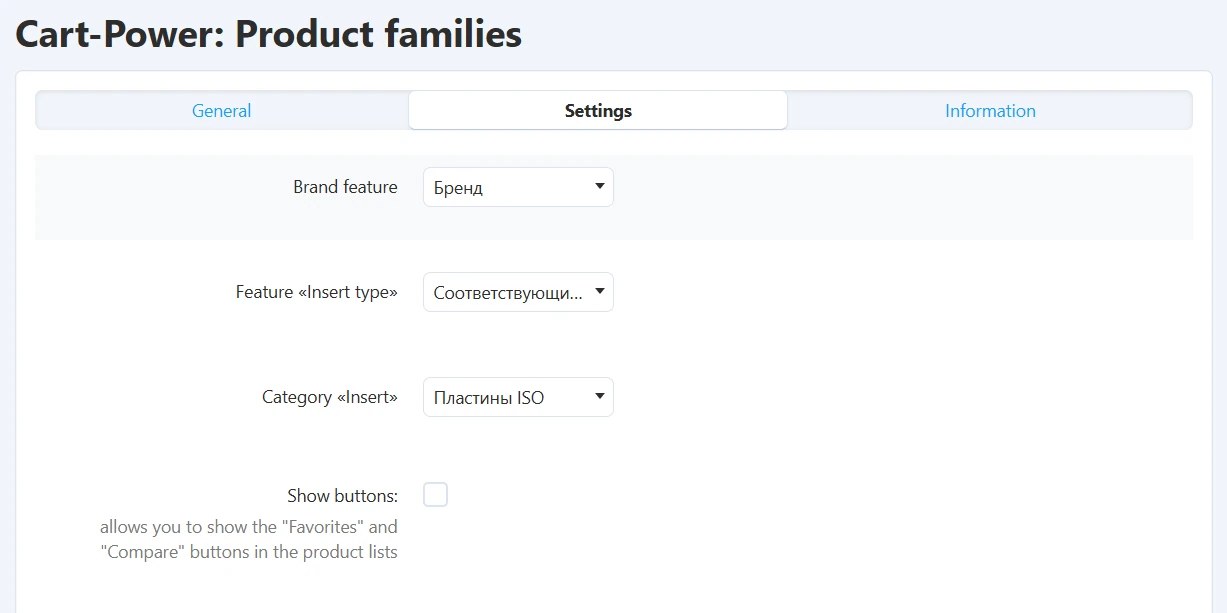
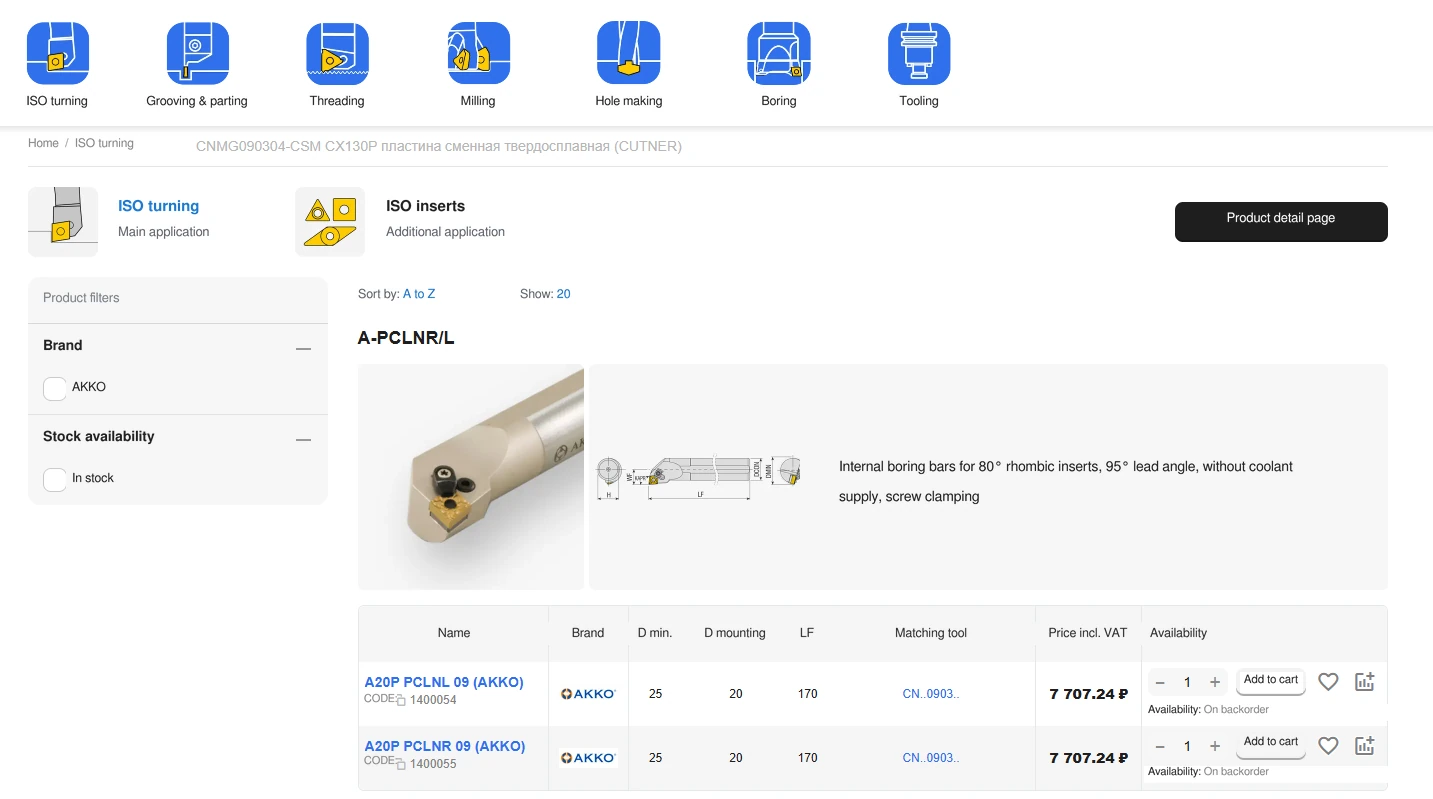
For this and similar tasks, we developed the “Product families” functionality. In the settings, the admin specifies which product feature (for example, “Insert type”) automatically generates a family page — a list of all compatible options. Buyers no longer need to compare specifications manually in the catalog or in technical documentation. They immediately see which items work together.
Setting the feature that generates the series page (admin panel)
Family page on the storefront: a list of compatible options
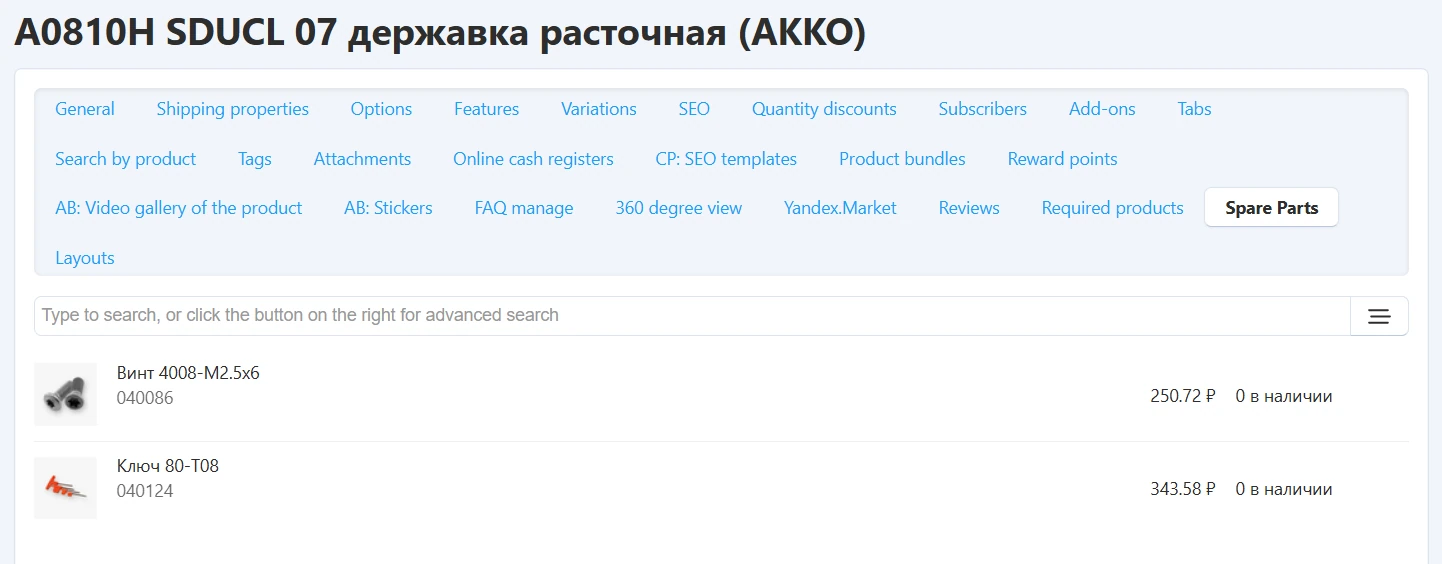
We also built a “Spare parts” tab on the product page: the admin can add a list of compatible spare parts to a product and import or export this data in bulk, which helps when working with a large catalog.
Reworking how product family appear in categories
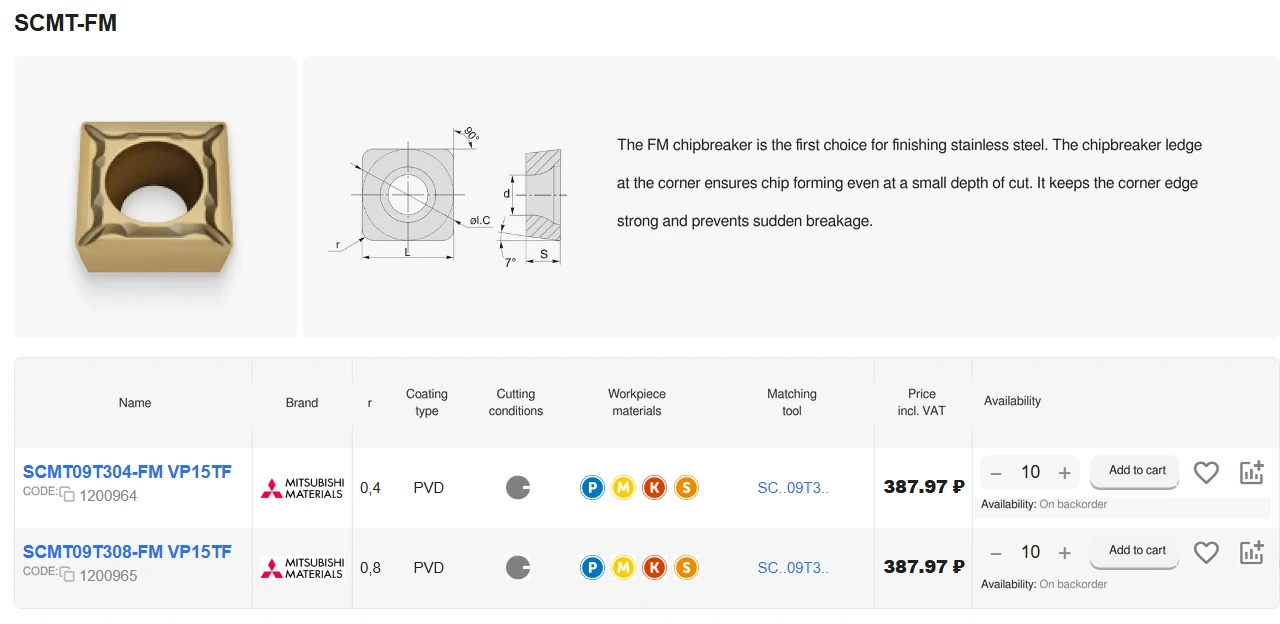
Previously, a category page showed only a list of series, and the buyer had to open a separate series page to see the products themselves. We took this functionality further.
All products in a category appear on a single page
and visually grouped by series.
A series tile view at the top of the listing
Clicking a series narrows the product list to that series, and a “Show all” button restores the full list.
Feature filters (shape, size, material, machining type, and others) work for both the series tiles
The tiles keep only the series that match the filter, and the tables keep only the matching products.
Buyers open a product page directly from a table row
The standalone series page remains available as an alternative route.
As a result, buyers no longer jump between pages to find a product in the series they need.
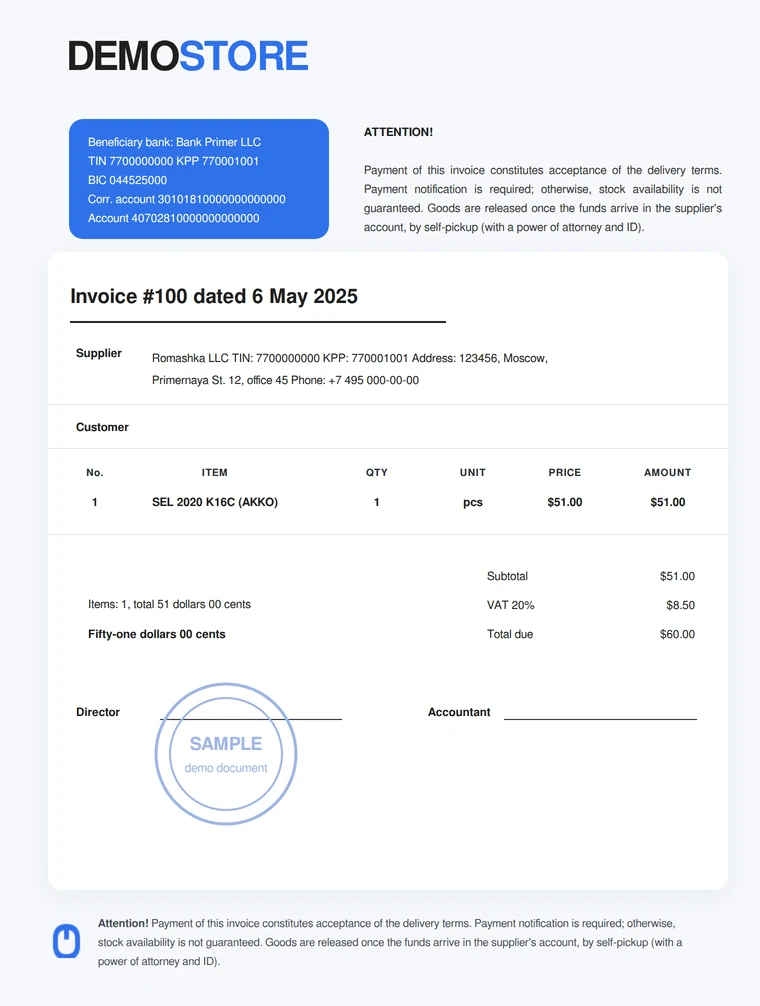
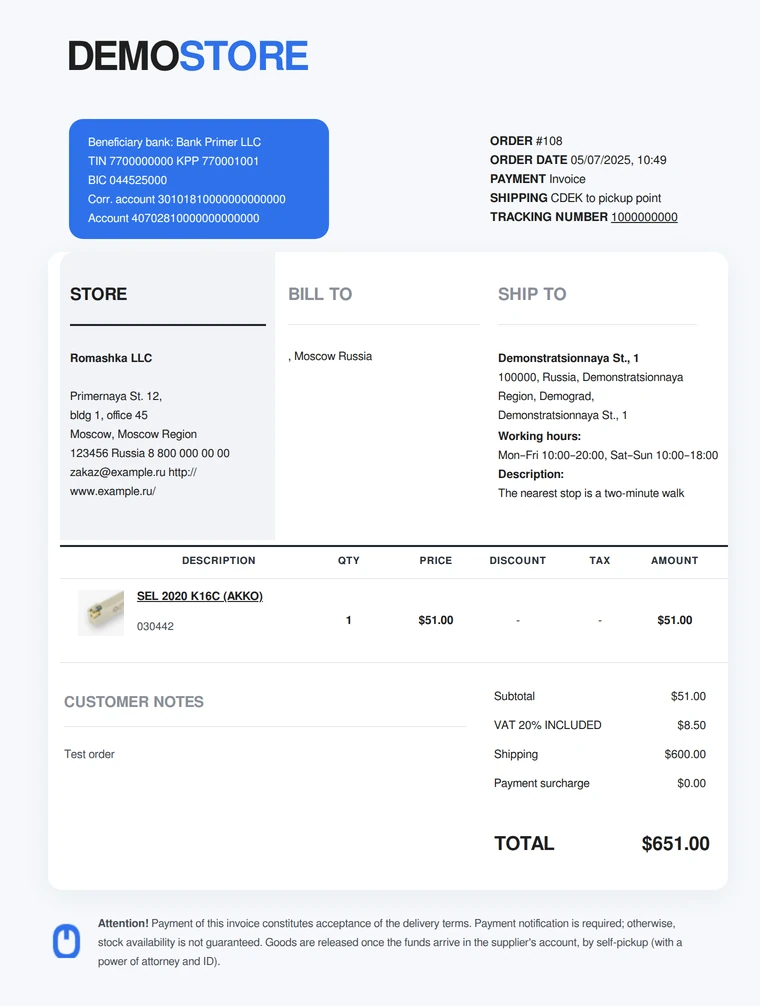
"Order" and "Invoice" document templates
We built the “Order” and “Invoice” documents based on the layout the client approved in Figma. For the invoice, we implemented correct page breaks so that the last line item and the totals block print on a new page when an order has many positions, added a fixed header and footer on every page of the document.
CS-Cart upgrade
About a year and a half into the engagement, we upgraded the platform: we moved from CS-Cart 4.18.3 to the current CS-Cart for online stores, Standard 4.19.1.SP2, updated the custom add-ons, and adapted the AB:UniTheme2 design theme to the new platform version. Every change was tested first and only then deployed to the live site — with no loss of data or functionality.
Migration to new hosting
We migrated the project to more stable hosting, which reduced a risk of technical failures in the future.
SEO
Alongside the technical work, we run systematic SEO: a keyword map of 10,000+ queries, content and landing pages built around demand, technical audits, GEO (visibility in AI search), and competitor analysis.
Results: organic traffic from Yandex (the leading search engine in Russia) has grown from 3 to 170+ visits per month, peaking above 450; search visibility is up almost 5 times; and a number of categories now rank in the top 3 to top 10. Work on the project continues.
Results
Correct data exchange between CS-Cart and 1C is in place, including goods tracking by customs declaration numbers and automatic recording of bank transfer payments; shipping and payment services are connected.
A custom add-on for selecting compatible inserts and spare parts has been developed. Buyers no longer have to check product compatibility manually in the catalog.
The display logic for series in categories has been reworked. Products are visible right on the category page, grouped by series, with a series tile filter synchronized with the feature filters.
The “Order” and “Invoice” documents have been built to the approved design, with correct pagination for printing and running headers and footers.
The site has been upgraded to CS-Cart Standard 4.19.1.SP2, with no loss of data or functionality.
The project has been migrated to more reliable hosting. Thanks to SEO, traffic from Yandex has grown 50 times.
We will add new growth and scaling opportunities to your business. We will extend the system’s functionality to match your business processes.
We will find solutions for everyone!
Share your idea and we’ll offer an optimal solution
Please, fill out the form
Please, fill out the form
We use cookies on our website to improve its functionality and enhance your user experience.
Continuing browsing this website, you agree with our Privacy Policy.